
AI
AI Virtual Teams for Enterprises: How NECLOSYS Automates Workflows and Helps Organizations Work Smarter
How AI-powered virtual teams support business functions, automate repetitive workflows and work alongside employees.
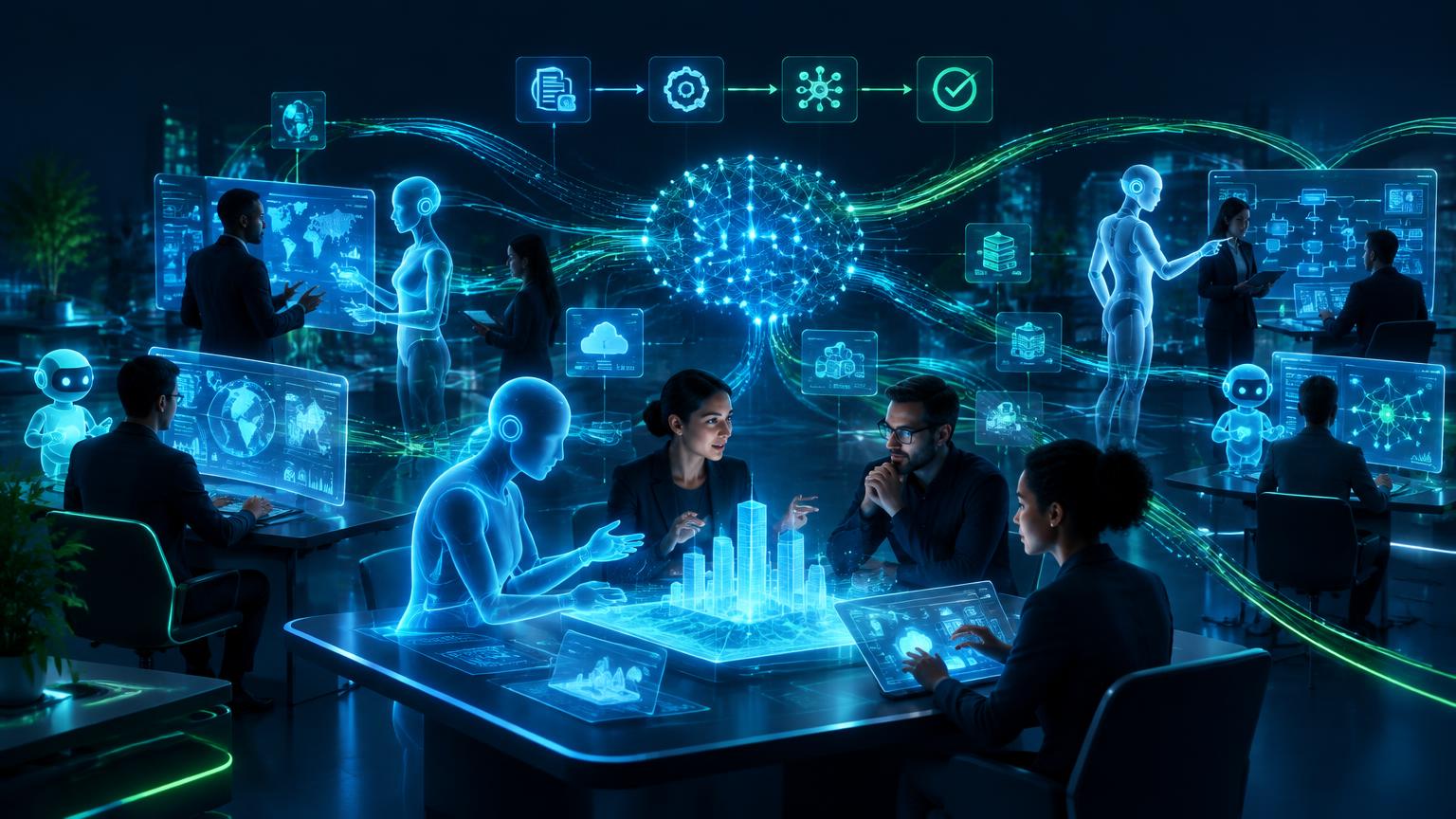
Artificial Intelligence is changing the way enterprises operate.
What once required multiple manual steps, repetitive communication and significant employee time can increasingly be supported through intelligent software, automation and AI-powered workflows.
The next evolution is not simply using an AI chatbot.
It is creating AI-powered virtual teams that can support business functions, automate repetitive workflows and work alongside employees.
For enterprises, this creates an opportunity to build a more responsive, efficient and digitally connected organization.
At NECLOSYS, we see AI automation as an important part of this transformation—helping enterprises identify repetitive processes, streamline workflows and create smarter ways of working.
What Is an AI Virtual Team?
An AI Virtual Team is a group of AI-powered digital agents or intelligent software capabilities designed to support different business activities.
Instead of asking one AI system to perform every task, enterprises can use specialized AI capabilities for specific workflows.
For example, an AI-powered virtual team could support:
- Customer communication
- Information collection
- Document processing
- Research and analysis
- Report preparation
- Internal knowledge management
- Workflow coordination
- Routine follow-ups
- Data organization
- Operational assistance
The objective is not simply to automate more tasks.
The objective is to create a smarter workflow in which AI handles suitable repetitive activities while employees focus on work that requires human judgment, creativity and expertise.
From Manual Processes to Intelligent Workflows
Many enterprises still depend on processes that involve multiple manual steps.
A typical workflow may look like:
Request → Employee → Data Collection → Verification → Processing → Follow-up → Report → Final Action
AI and automation can help streamline this process.
A more intelligent workflow could become:
Request → AI Agent → Information Processing → Automated Workflow → Human Review → Final Action
This can reduce unnecessary manual work and allow employees to spend more time on higher-value activities.
How NECLOSYS Helps Enterprises Automate
NECLOSYS focuses on helping organizations adopt digital technologies that improve connectivity, productivity and operational efficiency.
Our approach begins with the business process—not the technology.
Instead of asking:
“Where can we add AI?”
we believe enterprises should ask:
“Which business processes can be improved through intelligent automation?”
This shift can make AI adoption more practical and measurable.
1. Automating Repetitive Business Tasks
Employees often spend valuable time performing repetitive activities.
Examples include:
- Sorting information
- Preparing routine documents
- Responding to standard requests
- Organizing data
- Generating summaries
- Tracking follow-ups
- Preparing recurring reports
Where appropriate, AI-powered automation can handle or assist with these activities.
This allows employees to concentrate on tasks where human experience adds greater value.
2. Intelligent Customer Support
Customer expectations are changing.
People increasingly expect quick responses and convenient digital communication.
AI-powered systems can assist with routine customer interactions by understanding requests, providing relevant information and directing complex issues to human employees.
The result is not necessarily a completely automated customer service operation.
Instead, enterprises can create a human + AI customer experience where AI handles routine interactions and people handle situations requiring empathy, judgment or specialized knowledge.
3. AI-Assisted Research and Information Processing
Enterprises generate and receive large amounts of information every day.
Finding relevant information can consume significant employee time.
AI can assist with:
- Information discovery
- Document summarization
- Content classification
- Data organization
- Research assistance
- Knowledge retrieval
This can help employees reach relevant information faster and make workflows more efficient.
4. Smarter Document Workflows
Documents remain an important part of enterprise operations.
AI-powered systems can assist with extracting information, organizing documents, preparing summaries and supporting document-based workflows.
This can be particularly useful for organizations dealing with large volumes of structured and unstructured information.
5. Connecting AI With Existing Business Processes
One of the biggest challenges with AI adoption is that organizations often use disconnected tools.
An AI solution becomes more valuable when it can fit into the organization's existing digital environment.
The goal should be to create connected workflows rather than isolated AI applications.
For example:
AI → Data → Business Application → Workflow → Employee → Final Decision
This approach can help enterprises integrate intelligent capabilities into their existing operations.
AI Does Not Replace Human Intelligence
Responsible AI adoption requires a clear understanding of the role of humans.
AI can process information quickly and perform repetitive tasks, but enterprises still need people for:
- Strategic decisions
- Leadership
- Creativity
- Relationship management
- Complex problem-solving
- Ethical judgment
- Accountability
The strongest model is therefore not AI versus employees.
AI + People = Smarter Enterprise
AI becomes the digital assistant that helps employees work faster and more efficiently, while humans remain responsible for important decisions.
Why Enterprises Need an AI Automation Strategy
AI adoption without a clear strategy can create unnecessary complexity.
Before implementing automation, enterprises should evaluate:
Business Impact
What problem will the automation solve?
Data
What information will the AI system need?
Integration
How will the solution work with existing systems?
Security
How will business information be protected?
Human Oversight
Which decisions require employee approval?
Scalability
Can the solution grow with the organization?
Governance
Who is responsible for monitoring the system?
These considerations help organizations move from experimenting with AI to implementing it responsibly.
The NECLOSYS Approach
At NECLOSYS, our vision is to help enterprises move toward a more connected and intelligent digital environment.
We believe successful digital transformation requires more than adopting individual technologies.
It requires bringing together:
People + Processes + Data + Automation + Intelligent Technology
Our objective is to help enterprises identify opportunities where technology can simplify workflows, improve operational efficiency and support better digital experiences.
The Future of Enterprise Work
The enterprise workforce of the future may not consist only of human employees.
It may include a combination of:
Human Teams + AI Agents + Automated Workflows + Digital Systems
An employee may have an AI assistant for research.
A customer-service team may have AI agents handling routine requests.
An operations team may use intelligent workflows for repetitive processes.
Management may receive AI-assisted summaries and insights.
The result is a new model of work in which technology becomes an active part of the organization's digital workforce.
From Automation to Intelligent Enterprise
Automation has traditionally focused on making repetitive processes faster.
AI introduces another possibility:
Making workflows more intelligent.
Instead of simply following predefined steps, AI-powered systems can potentially understand information, identify patterns, assist with decisions and adapt their responses within defined boundaries.
This can help enterprises move from traditional automation toward intelligent automation.
The NECLOSYS Vision
The future of enterprise technology is not about replacing people with machines.
It is about giving people better digital tools.
When repetitive work is automated, employees can spend more time on strategy, innovation, customer relationships and meaningful problem-solving.
When business systems are connected, organizations can operate more efficiently.
And when AI is implemented responsibly, enterprises can build digital capabilities that are designed for the future.
NECLOSYS — Connecting Digital Possibilities
Automate the repetitive. Connect the digital. Empower the people. Build the enterprise of tomorrow.